EquiTests 2026: Precision Pattern Mastery via Kinematic Spatial Mapping
Revised Technical & Legal Audit Edition (2026 Compliance Update)
Author: Senior Equine Technology Analyst & Biomechanics Consultant
Classification: Engineering Assessment — Schooling Application Only
Executive Clarification
This revision incorporates:
- 2026 FEI regulatory updates
- Enhanced kinematic signal requirements
- Neurophysiological risk assessment
- Indoor spatial integrity corrections
The objective remains unchanged: evaluate EquiTests as a Kinematic Spatial Mapping Interface (KSMI) under realistic engineering and regulatory constraints.
This is not a promotional document. It is a performance and compliance audit.
I. Scientific Framework Revisited: Cognitive Load & Neuroplastic Boundaries
EquiTests is grounded in Cognitive Load Theory (CLT) — the principle that working memory is finite and susceptible to overload during high-density sequential tasks.
Audio Offloading reduces decisional fatigue by transferring pattern recall from working memory to timed cue delivery.
However, a necessary correction must be stated:
Neuroplasticity & Dependency Risk
Repeated external cue reliance may inhibit development of:
- Spatial Proprioception (internal arena mapping ability)
- Anticipatory motor sequencing
- Autonomous pattern encoding
From a neuroplastic standpoint, if the brain consistently delegates recall externally, intrinsic neural pattern mapping may weaken.
Engineering Conclusion:
EquiTests must be used in phased withdrawal cycles:
- Full cue assistance
- Reduced cue timing
- Silent execution validation
Failure to taper assistance risks cognitive dependency.
II. Kinematic Precision Upgrade
A. Outdoor GPS Requirements — Corrected
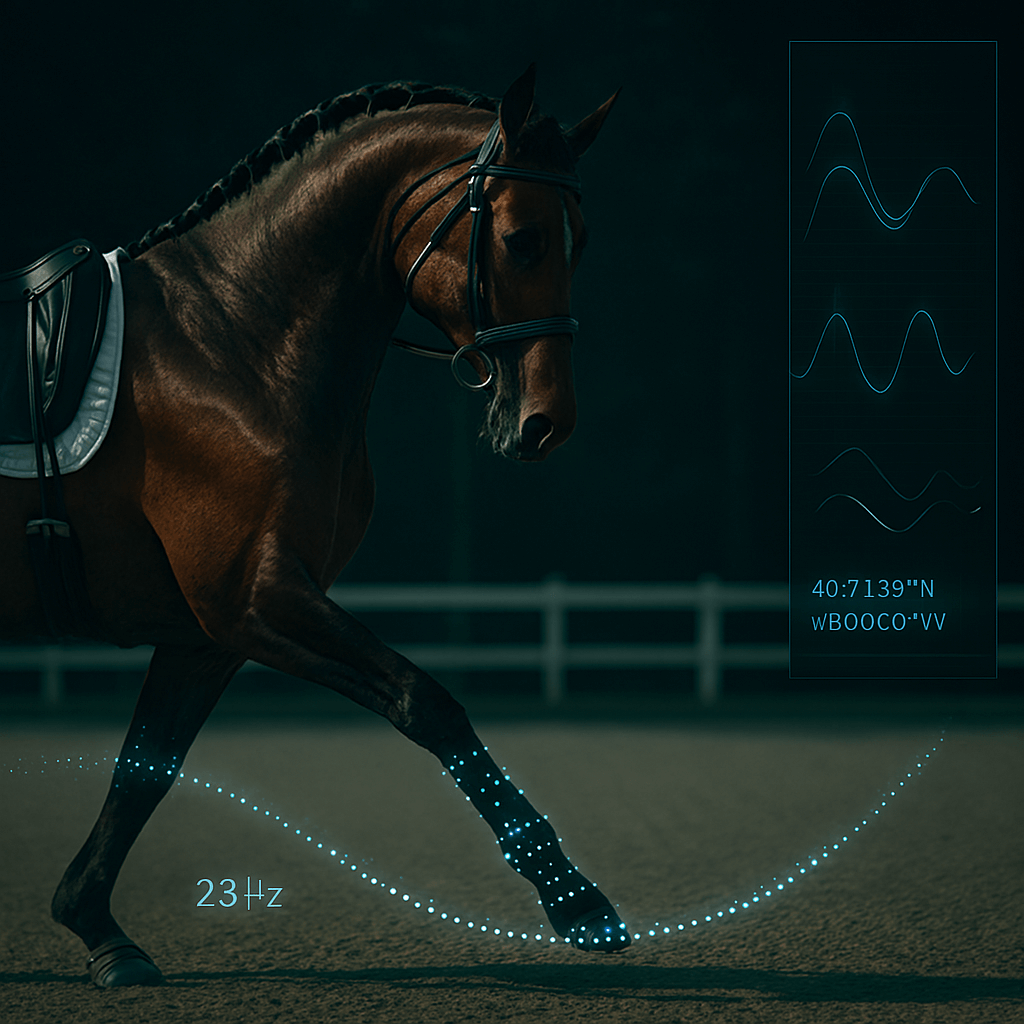
The previous 5Hz specification is insufficient for advanced lateral movements.
Updated Minimum Requirement:
| Parameter | Revised Standard |
|---|---|
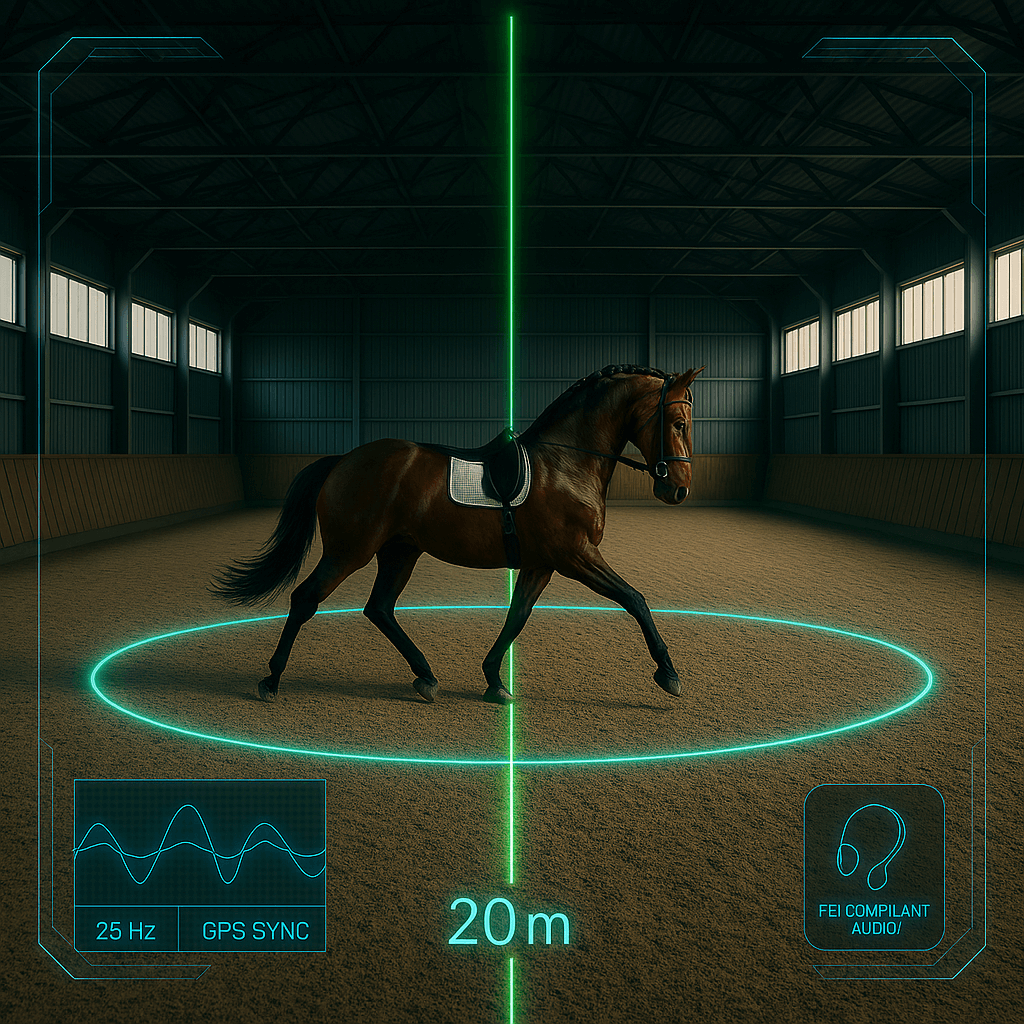
| Refresh Rate | 10Hz–25Hz |
| Path Resolution | Sub-decimeter |
| Positional Drift | ≤ 0.5m RMS error |
| Filtering | Adaptive Kalman or sensor fusion |
Why 5Hz Fails
Complex movements such as:
- Half-pass
- Pirouettes
- Collected canter transitions
require higher sampling rates to prevent:
- Signal lag
- Path smoothing distortion
- Lateral displacement miscalculation
At 5Hz, the system may skip critical micro-adjustments in stride.
10Hz is minimum functional.
25Hz is optimal for elite-level geometry analysis.
B. Indoor Signal Integrity — Multipath Distortion
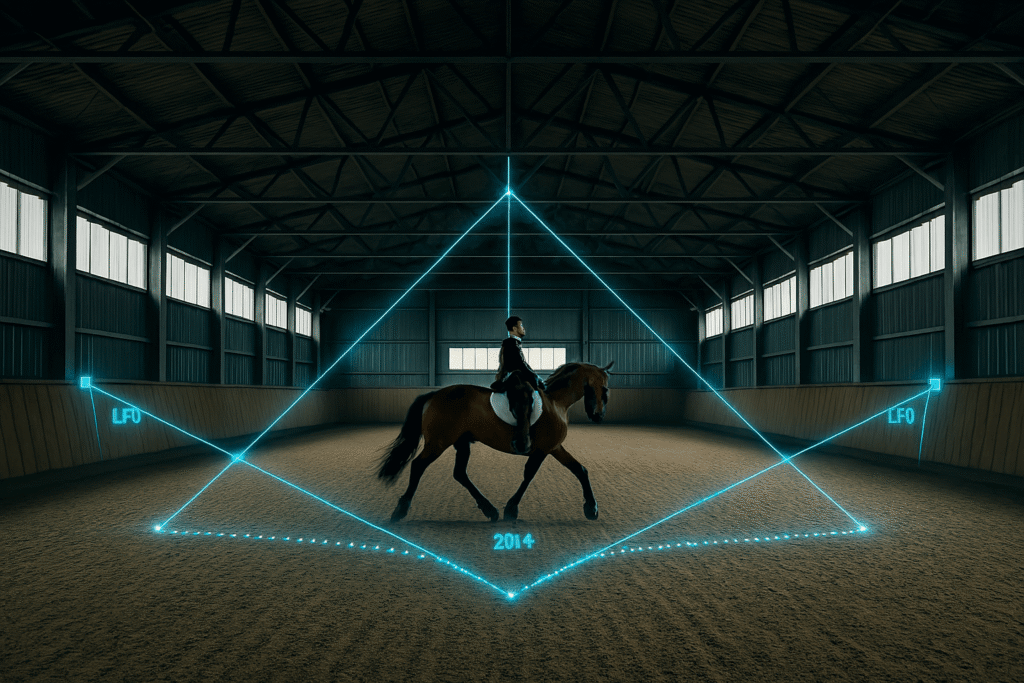
Indoor interference is not merely attenuation.
Metal roofing structures cause:
- Signal reflection
- Multipath distortion
- Positional spoofing
- Temporal delay stacking
GPS signals may appear valid while being geometrically incorrect.
Engineering Mandate
For indoor AR geometry:
Local Positioning Systems (LPS) or beacon-synchronized anchor grids are mandatory.
Without LPS:
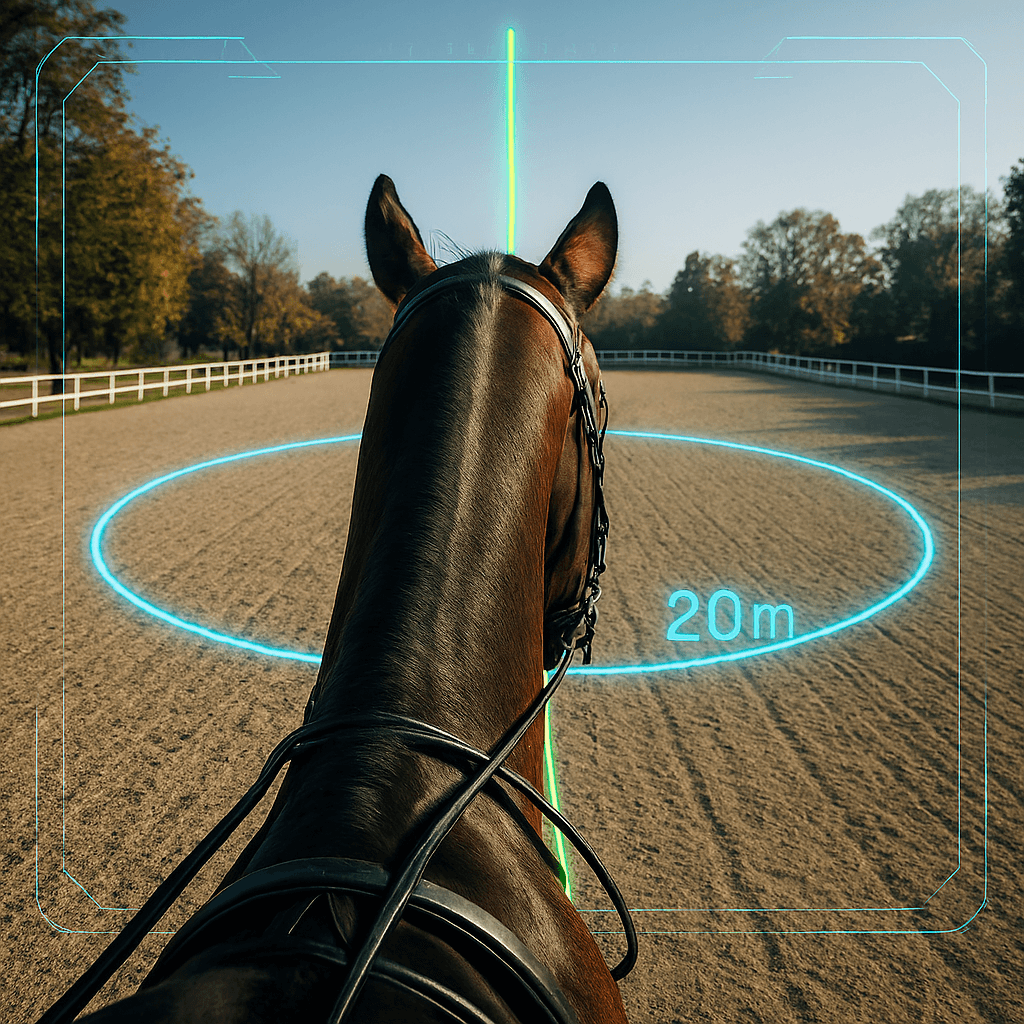
- AR centerlines drift
- Circle overlays distort
- Geometry validation becomes unreliable
Indoor GPS-only solutions are not technically defensible.
III. AR HUD Stability & Motion Dynamics
Motion Jitter Problem
Head-mounted or device-based AR overlays are vulnerable to:
- Rider vertical oscillation
- Rein-induced micro-movements
- Cervical rotation
This produces “motion jitter.”
Required Engineering Control
AR HUD systems must incorporate:
- Gyroscopic stabilization
- Accelerometer smoothing
- Predictive motion compensation algorithms
Without smoothing, riders may experience:
- Visual distraction
- Depth misperception
- Nausea in high-collection sequences
AR must stabilize relative to arena axes—not the rider’s head alone.
IV. Audio Delivery & Latency Integrity
Minimum specification remains:
- Bluetooth v5.3+
- Sub-40ms latency
- Adaptive codec correction
Latency beyond 40ms during collected sequences creates perceptible delay and reduces trust in cue timing.
V. Legal & Regulatory Compliance (2026 Update)
Governing References:
- FEI Article 428
- USEF DR121
- 2026 FEI General Regulations
Warm-Up Arena Restrictions (Updated)
Under 2026 FEI regulations:
- Athletes are prohibited from using dual earphones/headphones in the Warm-Up Arena.
- Only One (1) earphone may be used for safety and official communication compliance.
- Devices must not obstruct hearing of officials or emergency signals.
Bone-Conduction Clarification
While bone-conduction devices preserve environmental awareness, they are not exempt from earphone limitations.
Only one (1) active earpiece is permitted in warm-up areas.
High-Visibility Compliance Warning
- Holding a mobile phone while mounted in competition surroundings may result in an immediate Warning or Elimination.
- Use of dual earbuds in warm-up or competition surroundings may result in disciplinary action.
- Electronic assistance devices are strictly prohibited inside sanctioned competition arenas.
EquiTests is:
- A schooling tool only
- Not permitted during recognized competition performance
- Not a substitute for regulatory compliance
Failure to comply may result in elimination.
VI. Manual vs. Kinematic Model (Revised Technical Table)
| Variable | Manual Memorization | Audio Offload | Full Kinematic + LPS |
|---|---|---|---|
| Cognitive Load | High | Reduced | Reduced |
| Spatial Accuracy | Variable | Variable | High (with LPS) |
| Indoor Reliability | N/A | N/A | High (LPS required) |
| Sampling Fidelity | Human estimation | Human estimation | 10–25Hz precision |
| Dependency Risk | None | Moderate | Moderate–High |
| Compliance Risk | None | Moderate (if misused) | High (if misused) |
Technology increases performance potential — and regulatory exposure.
Data Integration with EquiCalc
To close the training-performance loop, EquiTests synchronizes raw spatial data with the EquiCalc 2026 Pillar Page framework. This allows for post-ride analysis of:
- Stride length consistency
- Transition timing
- Collection maintenance
- Lateral displacement variance
Technical Reference: For a detailed breakdown of the specific biometric formulas utilized in this synchronization, refer to the EquiCalc 2026: Data-Driven Equestrian Performance & Analytics.
VII. Offline Caching & Remote Operation
EquiTests must support:
- Offline test audio storage
- Arena geometry caching
- Local beacon sync data
Remote arenas frequently lack stable connectivity.
Reliance on cloud-only functionality is operationally fragile.
VIII. Performance Realism — Not Marketing Optimism
In tightly scored divisions, score margins may compress below 2%.
A single 5-point “Error of Course” penalty can shift:
- Ribbon placement
- Qualification status
- Championship ranking
EquiTests does not improve talent.
It reduces preventable technical error under controlled schooling conditions.
However:
- It introduces hardware dependency risk.
- It requires high-spec positioning systems.
- It carries regulatory exposure if misused.
Any adoption decision must weigh:
Engineering reliability
Cognitive integrity
Legal compliance
against the measurable benefit of eliminating avoidable penalties.
Final Assessment
EquiTests 2026 is technically viable only when:
- Outdoor tracking operates at 10–25Hz
- Indoor arenas deploy LPS systems
- AR overlays utilize gyroscopic smoothing
- Audio hardware complies with FEI single-ear requirements
- Riders implement phased cognitive withdrawal
Without those conditions, performance claims weaken.
With them, the system becomes a structured training interface capable of reducing high-cost execution errors.
That is the objective engineering position.
Sources & Further Reading
FEI General Regulations 2026 (Official Rules PDF) – International governing body portal with downloadable FEI General Regulations including Article 428 on outside assistance and electronic devices. FEI General Regulations & Statutes Hub (includes Article 428)
USEF Dressage Rulebook DR121 (National Competition Rules) – U.S. Equestrian Federation rulebook section defining outside assistance and communication device restrictions. (Direct PDF location available via USEF official site.)
USDF Dressage 2026 Guide (Tests & Scoring) – United States Dressage Federation official guide with test descriptions and penalty definitions. (Available on USDF official site.)
Sweller J. (1988) – Cognitive Load During Problem Solving – Full PDF of the foundational CLT paper on working-memory processing limits and schema acquisition. Sweller 1988 Cognitive Load Paper (PDF)
Paas, F., Renkl & Sweller (2003) – Cognitive Load Theory Developments – Overview of CLT advances in instructional design principles. (Accessible from educational psychology journals via Springer or institutional access.)
Beilock & Carr (2001) – Choking Under Pressure in Skilled Performance – Journal article discussing decisional fatigue effects in skilled tasks. (Searchable through APA PsycNet or university library.)
Pfau, Witte & Wilson (2005) – High‑Speed GPS for Equine Locomotion – Journal of Experimental Biology article validating GPS tracking at higher read rates for motion analysis. (Available via institutional journal access.)
Warner, Koch & Pfau (2010) – Inertial Sensors & High‑Frequency GPS in Gait Analysis – Study in Equine Veterinary Journal on multi‑sensor precision tracking. (Available through Wiley Online Library.)
Kaplan & Hegarty (2017) – Understanding GPS/GNSS Principles – Technical book explaining multipath distortion and satellite signal challenges. (Published by Artech House; widely available through libraries.)
Gu, Lo & Niemegeers (2009) – Survey of Indoor Positioning Systems – IEEE Communications Surveys & Tutorials review of indoor spatial positioning technologies. (Available on IEEE Xplore.)
Azuma (1997) – A Survey of Augmented Reality – Foundational AR paper on spatial registration and virtual overlay principles. (Available through MIT Press or academic databases.)
Jerald (2015) – The VR Book: Human‑Centered Design for VR – Covers motion‑to‑photon latency and perceptual stability relevant to AR HUD systems. (Published by Morgan & Claypool; available online.)
Bluetooth SIG (2021) – Bluetooth Core Specification v5.3 – Official Bluetooth Special Interest Group technical standard defining low‑latency protocols. (Downloadable from Bluetooth SIG website.)
Nordic Semiconductor (2023) – Low‑Latency Audio Over Bluetooth LE Guidelines – Manufacturer application note on BLE audio latency optimization. (Accessible via Nordic Semiconductor developer site.)